- All
- Product Name
- Product Keyword
- Product Model
- Product Summary
- Product Description
- Multi Field Search
Please Choose Your Language


Views: 0 Author: Site Editor Publish Time: 2026-07-14 Origin: Site


Inadequate spot cooling in B2B environments carries severe operational risks. Employee heat stress rapidly lowers daily productivity. Overheating equipment can also trigger costly sudden shutdowns. You simply cannot afford these preventable disruptions in your facility. Standard residential fans cannot survive heavy-duty industrial environments. Facility managers require reliable, high-velocity airflow from their equipment. These commercial units must withstand harsh conditions constantly without failing. Dust, moisture, and continuous operation demand a robust cooling solution. This guide provides a clear framework for evaluating your exact cooling needs. We cover essential performance specs, durable motor types, and highly specialized features. You will learn how to choose the right equipment for your operational space. We ensure you secure long-term reliability while maintaining strict OSHA safety compliance.
Choosing the right pedestal fan requires matching CFM (Cubic Feet per Minute) ratings to the specific square footage and heat load of your facility.
Motor enclosure types (such as TEFC vs. ODP) are critical decision factors for dusty, wet, or hazardous work environments.
Specialized models, like a misting oscillating pedestal fan, offer targeted temperature drops for open-air commercial spaces and high-heat loading docks.
You must define what constitutes successful cooling for your specific zone. Some facilities prioritize basic personnel comfort near workstations. Others need aggressive condensation reduction to prevent slippery floors. Many welding shops require rapid fume dispersal to maintain safe air quality. Establish your primary goal before reviewing any equipment specifications. Knowing your exact objective prevents you from buying incorrect equipment.
Next, consider why a Pedestal Fan often outshines alternative cooling methods. High-Volume Low-Speed (HVLS) ceiling fans work well for massive, unobstructed spaces. Permanent HVAC routing provides total climate control. However, these massive installations require significant capital investment and long installation times. A commercial pedestal unit offers unmatched portability. You can roll it directly into hot spots during peak summer shifts. It delivers targeted directional airflow exactly where your employees need it most. You also benefit from a significantly lower deployment cost, allowing you to cool multiple zones affordably.
Finally, map out your operational environment baseline. Assess the average ambient temperature during peak operational shifts. Identify airborne particulates like heavy sawdust or airborne kitchen grease. You must also measure your available floor footprint. This ensures the equipment fits safely in high-traffic areas without creating tripping hazards. A thorough environmental baseline guarantees you select a unit built for your specific reality.
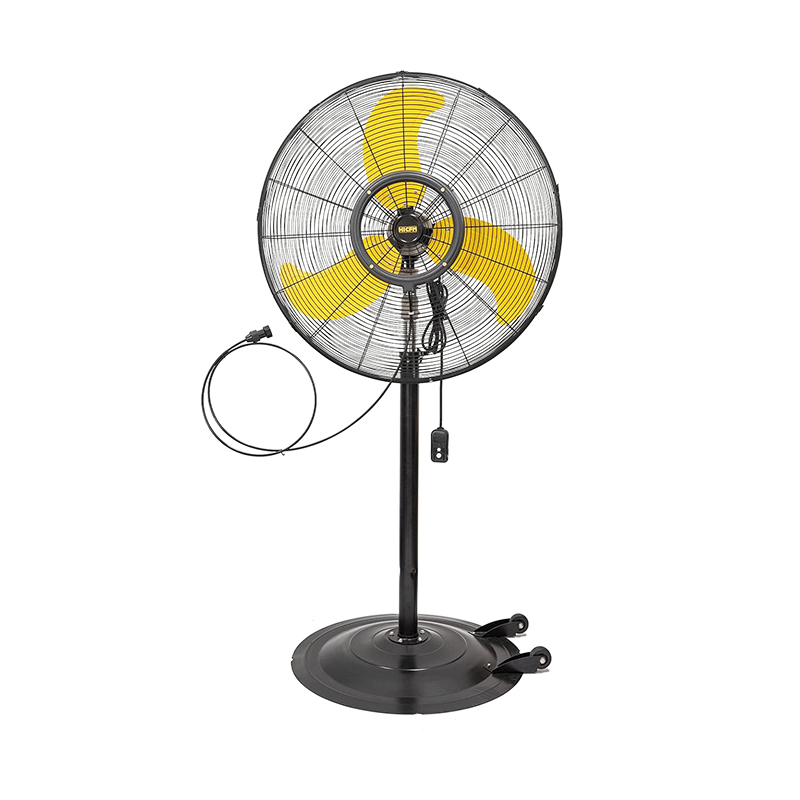
You cannot guess your airflow requirements. Calculate your required CFM using a simple standard formula. Follow these straightforward steps:
Calculate the total cubic volume of your target space by multiplying length, width, and ceiling height.
Determine your target air exchanges per hour based on your industry standards.
Multiply the total room volume by your target air exchanges.
Divide the final number by 60 minutes to find your exact required CFM.
Do not just look at peak CFM ratings on a spec sheet. Consider the crucial relationship between blade pitch and motor RPM. A steep blade pitch paired with high RPM creates a tighter, more forceful velocity profile. This pushes air much further across a large room, effectively increasing your throw distance. High throw distance matters greatly in long warehouse aisles.
Motor enclosures dictate where you can safely operate your equipment without risking premature failure.
ODP (Open Drip Proof): These motors pull outside air directly over their internal windings to cool themselves. They work best for clean, dry, indoor commercial environments. Gyms, cafeterias, and clean retail warehouses fit this operational profile perfectly.
TEFC (Totally Enclosed Fan Cooled): This rugged design seals the motor core entirely. It relies on a secondary external fan to blow air over the casing for cooling. It proves absolutely essential for industrial settings facing dust, debris, or heavy moisture. You must use TEFC units in woodworking shops, automotive bays, and metal fabrication floors.
Always demand continuous-duty rated motors for heavy industry. They include vital thermal overload protection. This safety feature prevents catastrophic motor burnout during grueling multi-shift operations.
Workplace safety remains non-negotiable for facility managers. Always specify OSHA-compliant concentric wire guards. The spacing between the wire rings must remain strictly less than 0.5 inches. This tight spacing prevents fingers, tools, and loose clothing from contacting spinning fan blades.
Stability presents another major operational concern. High-traffic corridors require heavy-duty, heavily weighted bases. Cast-iron bases prevent accidental tipping when employees or moving carts bump the equipment.
Finally, rigorously evaluate the acoustic output. Manufacturers measure noise levels in decibels (dB). Heavy industrial zones tolerate higher noise levels easily. However, commercial spaces like restaurants or retail stores require significantly quieter operation. High decibel levels will ruin the customer experience and distract your administrative staff.
Evaporative cooling leverages the basic thermodynamics of flash evaporation. The fan pump forces high-pressure water through tiny specialized nozzles. This action creates an ultra-fine water mist. The mist quickly absorbs heat energy from the surrounding ambient air as it evaporates. This rapid phase change creates an immediate and noticeable temperature drop. It works exceptionally well in low-to-medium humidity environments where water evaporates instantly.
You will find distinct cooling applications across several different commercial sectors.
In commercial settings, an integrated Misting Oscillating Pedestal Fan reliably cools outdoor dining patios. Theme parks, resort pools, and hospitality event spaces also rely heavily on them. They reduce ambient temperatures significantly without wetting tables, food, or patrons.
Industrial sectors utilize them quite differently. Open loading docks trap immense, dangerous heat during summer months. Agricultural barns and automotive garages also struggle to maintain safe working temperatures. Traditional air conditioning proves completely economically unviable for these massive open spaces. Evaporative cooling solves this exact problem safely and affordably.
You must intelligently decide between oscillation and fixed-head operation. Oscillation slowly sweeps a broad area. It works perfectly for cooling a wide assembly line or a large outdoor patio full of guests. However, it wastes critical energy if you only need to cool a single stationary machine operator. Lock the fan head in a fixed, targeted position for localized individual workstations.
Misting systems require reliable and clean water access. Some permanent models require direct hose connections for continuous, all-day operation. Others feature built-in portable water reservoirs for maximum mobility around a job site. Always install inline water filters before running your system. Hard tap water contains heavy minerals like calcium. These dissolved minerals quickly cause severe nozzle calcification. Inline filters prevent microscopic clogs and drastically reduce your routine maintenance workload.
Different environments demand entirely different equipment specifications. You must align your fan choice directly to your daily operational hazards. Choosing the wrong setup guarantees poor performance and short equipment life.
Massive distribution centers require aggressive and sustained air movement. Focus on high-CFM, non-oscillating units. You need to push massive columns of air straight down extremely long aisles. Fixed heads effectively drive cool air deep into hot shipping containers during loading operations. This targeted approach keeps logistics teams safe during peak afternoon heat.
Heavy industry requires maximum equipment durability. Prioritize TEFC motors to actively repel airborne contaminants. Select models featuring thick aluminum blades. Aluminum naturally resists sparking, ensuring critical safety around volatile chemicals or combustible dust. Heavy-duty cast-iron mounts are also strictly necessary here. They withstand constant forklift vibrations and heavy warehouse foot traffic without tipping over.
Customer-facing environments require a highly balanced approach to cooling. Focus on easily cleanable ODP motors. Choose medium-CFM ratings to avoid disrupting the space with harsh winds. You must prioritize quieter operating profiles above all else. High noise levels ruin the customer experience in upscale fitness centers and busy hospitality venues.
Facility Specification Matrix
| Facility Type | Recommended Motor | CFM Strategy | Primary Feature Focus |
|---|---|---|---|
| Logistics Hubs | ODP or TEFC | High CFM | Fixed head for long warehouse aisles |
| Metal Fabrication | TEFC | High CFM | Spark-resistant aluminum fan blades |
| Commercial Gyms | ODP | Medium CFM | Low decibel acoustic sound profile |
| Outdoor Patios | TEFC (Outdoor Rated) | Variable CFM | Misting and broad oscillation capabilities |
The best cooling equipment aligns specific performance metrics directly to your exact environmental hazards. You must carefully match your CFM output and motor enclosure rating to the physical space. Specialized features like misting and broad oscillation provide incredible value when deployed correctly. Proper equipment selection prevents frequent motor failure and keeps your entire workforce completely safe.
Take immediate action to improve your facility cooling strategy today. First, accurately measure the square footage of your target cooling zone. Next, audit your facility for dangerous airborne dust and high moisture levels. Finally, consult detailed supplier specification sheets. Compare CFM ratings and motor types carefully to finalize your equipment shortlist.
A: Use a simple volume formula. Multiply the room's length, width, and height to find total cubic feet. Multiply this volume by your desired air exchanges per hour. Divide that number by 60 minutes. This gives your target CFM. A standard warehouse typically requires 6 to 10 air exchanges hourly.
A: The main differences lie in motor housing and construction materials. Industrial models feature TEFC motors for dust protection. They use durable aluminum or steel blades. They also carry continuous-duty ratings for non-stop operation. Commercial fans typically use ODP motors and lighter materials suited for clean, dry indoor environments.
A: You should only use them indoors under specific conditions. The space must have low ambient humidity and excellent cross-ventilation. Poor ventilation traps moisture and causes indoor condensation pooling. They work best in large, open-air facilities like loading docks or large warehouses where rapid flash evaporation occurs safely.
A: TEFC stands for Totally Enclosed Fan Cooled. This design seals the internal motor components away from outside air. It prevents dust, airborne debris, and water ingress from destroying the motor. This protection drastically extends equipment lifespan in harsh environments like metal fabrication shops or agricultural barns.


