- All
- Product Name
- Product Keyword
- Product Model
- Product Summary
- Product Description
- Multi Field Search
Please Choose Your Language


Views: 0 Author: Site Editor Publish Time: 2026-07-08 Origin: Site


Standard residential cooling solutions die quickly in high-dust, high-heat environments. You bring a standard box fan into a workshop, and it chokes on sawdust within weeks. Heat destroys weak motors easily. Constant demand breaks cheap plastic mounts. Buying a cooling device for these rough areas requires a completely different mindset. You are investing in a comprehensive ventilation system. It protects expensive equipment. It maintains safe working conditions for everyone on the floor. It must survive intense industrial wear and tear.
This guide provides a technical, no-nonsense framework. We help you evaluate, size, and select the right heavy-duty cooling equipment for your specific space. You will learn to calculate exact airflow needs based on room volume. You will discover why specific motor enclosures dictate overall lifespan. You will also understand the vital safety and structural mounting requirements needed to prevent workplace hazards.
Motor housing dictates lifespan: Totally Enclosed Non-Ventilated (TENV) or Totally Enclosed Fan-Cooled (TEFC) motors are non-negotiable for woodworking or dusty shops.
CFM determines capacity, not blade size: Calculate your required Cubic Feet per Minute (CFM) based on space volume, ignoring marketing claims about "cooling area."
Oscillation vs. Fixed: An oscillation wall fan provides broader air circulation for commercial spaces, while directional fixed fans are better for targeted spot-cooling in workshops.
Mounting matters: Heavy-duty fans require structural mounting (studs/concrete) due to high vibration and torque—drywall anchors will fail.
Sawdust, metal shavings, and commercial dirt constantly float in workshop air. These particles quickly penetrate open-vented residential motors. Once inside, debris coats the electrical windings. This buildup traps heat effectively. The motor overheats and experiences catastrophic failure rapidly. You cannot simply clean it out afterward. The damage becomes permanent. We see standard fans burn out constantly in active workshops.
Vibration causes another massive hardware issue. Cheap retail models use flimsy stamped metal blades. These blades are rarely balanced properly from the factory. They wobble slightly during every single rotation. This wobble creates low-frequency vibration. We call this hardware fatigue. The constant shaking transfers directly into the mounting bracket. Screws slowly back out of the wall over time. Cheap drywall anchors pull loose completely. Suddenly, a heavy metal object falls from above. This presents a massive safety hazard for anyone working below.
Volume versus velocity confuses many buyers. Retail models blow a fast, tight stream of air. You feel a strong breeze right in front of them. Step two feet away, and you feel absolutely nothing. We call this velocity cooling. Rough environments need volume cooling instead. A true heavy-duty unit moves massive volumes of heavy, stagnant air. It pushes hot air out of distant corners. It replaces toxic fumes with fresh air. It utilizes deep-pitched blades. These blades grab massive chunks of air per revolution, changing the entire climate of your garage.
Sizing airflow requires basic math. We do not guess. We use the CFM formula. First, calculate the total room volume. Multiply the length, width, and height of your space. A 20 by 20 garage with a 10-foot ceiling equals 4,000 cubic feet. Next, determine your required air exchange rate. Most active workshops need a full air exchange every two to three minutes.
Divide your room volume by this exchange rate. You need roughly 2,000 CFM for a slow exchange. You need 4,000 CFM for a fast, aggressive cooling cycle. Aim for 3,000 to 4,000 CFM in standard two-car garages. Commercial warehouses and larger bays often require 8,000+ CFM per unit to remain effective.
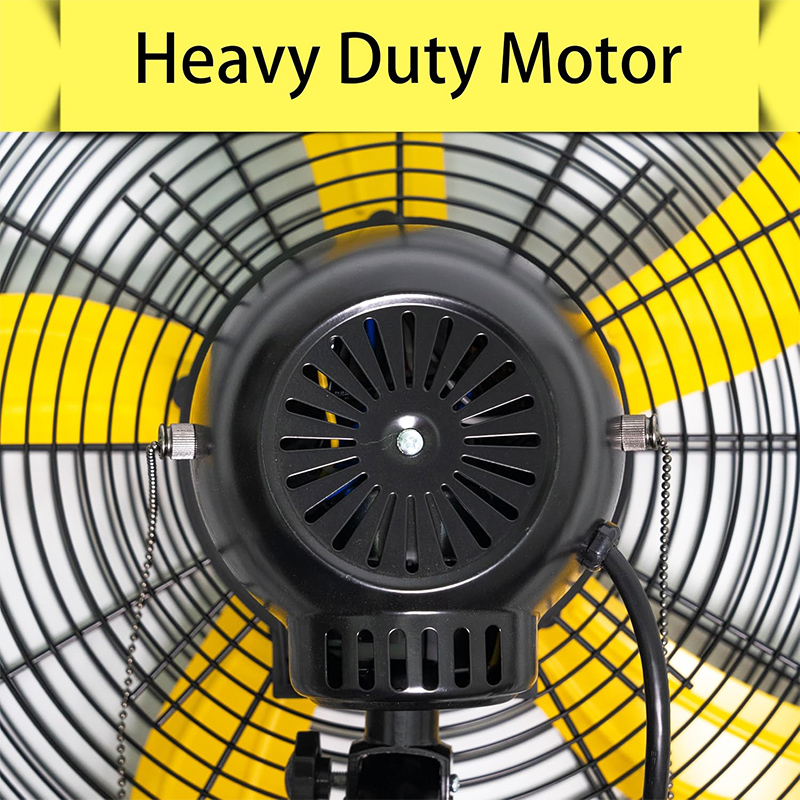
Motor enclosures decide your unit's ultimate survival. We primarily look at two main types: ODP and TEFC. ODP stands for Open Drip Proof. TEFC stands for Totally Enclosed Fan-Cooled.
| Feature | ODP (Open Drip Proof) | TEFC (Totally Enclosed Fan-Cooled) |
|---|---|---|
| Airflow Design | Outside air flows directly through internal windings. | Sealed casing; external fan blows air over cooling fins. |
| Dust Resistance | Low. Prone to clogging in dusty environments. | Maximum. Dust cannot reach electrical components. |
| Ideal Environment | Clean commercial spaces, gyms, storage areas. | Carpentry shops, welding bays, auto-detailing, outdoors. |
ODP allows air to pass directly over the internal windings. This keeps the motor cool cheaply. It works perfectly in clean, dust-free commercial spaces. TEFC motors are completely sealed. Outside air never touches the internal electronics. This design dissipates heat safely without exposing vulnerable parts. TEFC is mandatory for carpentry shops. Paint fumes and sawdust will destroy ODP motors quickly. Always verify the enclosure type before finalizing your purchase.
Noise levels correlate directly with overall performance. High CFM ratings demand high motor RPMs. They also require aggressive blade pitches to move air. This combination cuts through the atmosphere violently. It creates significant operational noise. Industrial models often operate between 60 and 75 decibels. Some exceed 85 decibels on their highest settings.
You cannot escape this physical reality. Moving massive air volumes is loud. We recommend buying models equipped with variable speed controllers. Avoid relying on basic two-speed pull chains. Variable controllers let you dial down the RPMs smoothly. You can reduce noise when you need to have a conversation. You can crank it back up to maximum capacity when operating loud machinery.
Fixed airflow models serve highly specific purposes. We choose them for targeted spot-cooling. You might have a dedicated welding station or workbench. A fixed unit blows directly on the operator constantly. You might need to push exhaust fumes out of a single bay door. A directional fan handles this task perfectly. They are also excellent for drying specific materials quickly in paint bays. Fixed models contain fewer moving parts. They lack internal oscillation gears entirely. Less moving parts equals a significantly lower failure rate. They survive extreme industrial conditions much longer. We highly recommend a fixed Wall Fan when raw durability is your top priority.
Oscillating models solve entirely different workspace problems. They sweep cool air systematically across wide areas. We choose them for wide, shallow workspaces. Commercial gyms rely on them heavily. Multi-bay garages benefit immensely from sweeping air. Personnel constantly move around these dynamic environments. An Oscillation Wall Fan ensures everyone feels the breeze eventually without adjusting the equipment.
However, you must exercise extreme caution. The internal oscillation gearbox remains highly vulnerable. It is often the first point of failure in cheaper retail models. Plastic gears strip out quickly under constant torque. They snap instantly if someone forces the fan head manually. We advise looking strictly for all-metal gear construction. You should also look for adjustable sweep angles. This feature prevents the unit from blowing air uselessly directly into corner walls.
Mounting requires serious structural integrity. We already discussed the dangers of vibration fatigue. High torque causes "vibration walking." The bracket literally walks its way out of the wall over time. You must mount these units directly to solid structural elements. Use heavy-duty lag bolts. Drive them deeply into solid wood studs. Mount them to masonry using proper concrete anchors. Secure them to steel I-beams using industrial clamps. Never use hollow-wall drywall anchors. Standard drywall cannot support the dynamic load of industrial motors. The unit will eventually tear the drywall out entirely.
Power delivery presents another major challenge. Many buyers simply plug them into the nearest available outlet. This often requires running long extension cords across the floor. Long cords create severe trip hazards in active commercial spaces. Forklifts roll over them constantly. Employees trip on them during busy shifts. Cords also experience electrical voltage drop over long distances. This starves the motor of necessary power and causes dangerous overheating.
We highly suggest hardwiring heavy-duty units. Hire a licensed electrician for this step. Have them wire the unit directly into a dedicated 15A or 20A circuit. This eliminates cord hazards entirely on your floor. It ensures clean, consistent power delivery. It becomes absolutely crucial if you run multiple high-draw units simultaneously.
Compliance requirements matter greatly for B2B buyers. Business owners must proactively protect their employees. OSHA dictates strict safety standards for exposed moving fan blades. You need OSHA-compliant grille guards. These guards feature tight, finger-safe wire spacing. A worker cannot accidentally stick a finger into the blade path. Additionally, you must verify UL or ETL safety certification. Commercial insurance policies demand these safety certifications universally. Uncertified equipment can void your liability coverage immediately after a workplace accident.
Identify your primary workspace constraint first. Every space has a limiting factor you must overcome. Are you optimizing for maximum dust resistance? Focus heavily on TEFC motor options. Do you need maximum square-footage coverage? Focus on high CFM ratings and robust oscillating models. Are you dealing with strict workplace noise limits? Prioritize variable speed controllers and slightly lower RPM configurations. Knowing your main constraint narrows the field instantly.
Verify commercial warranties carefully before checking out. Many popular consumer brands look tough on the outside. They market themselves aggressively as heavy-duty. However, check their fine print. They often void the warranty immediately if installed in a commercial or retail space. They also void it if installed in a non-climate-controlled environment like a hot garage. Look for brands that explicitly guarantee commercial use in writing.
Take these actionable next steps. Do not buy blindly online. Follow a proven structural process.
Measure your room's exact length, width, and height.
Calculate the total cubic volume to find your baseline CFM requirement.
Use a stud finder to map out viable structural mounting locations on your walls.
Verify your shop's daily dust levels to decide between ODP and TEFC enclosures.
Narrow your options to two or three specific models meeting these strict criteria.
Buying cooling equipment for harsh spaces remains a strict mathematical calculation. You must match your total room volume to the unit's CFM output. You must match the motor enclosure strictly to your daily dust levels. You must match your mounting hardware safely to the dynamic vibration load. Prioritize heavy-duty motor protection above all else. Ignore flashy smart features or sleek aesthetics. A sealed, powerful motor guarantees a strong return on your investment. It ensures years of reliable, safe cooling in the toughest working environments.
A: Typically 3,000 to 5,000 CFM, depending on ceiling height and desired air exchange rate. Larger volumes or frequent open doors require the higher end of this range for effective cooling.
A: Not for standard parking or basic storage. However, it is highly recommended if you do woodworking, sanding, or painting. Sawdust and fumes will quickly destroy open-vented motors.
A: Yes, provided they have thermally protected motors. They are built for long hours, but you should always verify the specific duty-cycle rating from the manufacturer before running them 24/7.
A: No, wall fan bearings and oscillation mechanisms are engineered strictly for horizontal loads. Using them overhead is dangerous. You must use a dedicated ceiling fan for overhead mounting applications.


