- All
- Product Name
- Product Keyword
- Product Model
- Product Summary
- Product Description
- Multi Field Search
Please Choose Your Language


Views: 0 Author: Site Editor Publish Time: 2026-07-05 Origin: Site


Beating the heat in massive indoor environments requires serious mechanical power. Warehouses, expansive gyms, and oversized commercial garages trap stagnant heat very quickly. To move massive volumes of air effectively, facility managers consistently turn to high-velocity industrial fans.
However, picking the wrong fan profile creates immediate logistical headaches. An incorrect choice often results in obstructed airflow and heavily wasted floor space. You might even fail to circulate air over essential obstacles, leaving your workers miserable. Stagnant air leads to moisture buildup and trapped fumes.
This guide delivers a detailed, evidence-based comparison between drum and pedestal models. We will break down airflow trajectories, footprint requirements, and practical placement strategies. By the end, facility managers and homeowners can confidently make a secure, space-appropriate purchasing decision.
Drum Fan (Commercial Barrel Fan) supremacy: Best for sheer air volume (CFM) and broad ground-level circulation; requires significant floor footprint.
Pedestal Fan utility: Ideal for localized cooling, pushing air over workbenches or inventory, and minimizing trip hazards.
The Noise Trade-off: Both are high-velocity models; expect industrial decibel levels. Purchasing decisions should prioritize layout and airflow trajectory over noise reduction.
Decision Matrix: Choose drum fans for raw cubic-foot air replacement; choose pedestal fans for targeted, adjustable directional cooling.
Stagnant air creates serious hazards inside large industrial footprints. Workers suffer in uncomfortable, sweltering conditions when temperatures rise. Moisture builds up along concrete floors, creating immediate slip hazards. Dangerous fumes gather quickly in poorly ventilated corners. You need efficient, total air turnover to solve these issues. A simple, localized breeze will not fix the underlying problem.
Industry standards measure cooling power using Cubic Feet per Minute (CFM). High-velocity models often share surprisingly similar internal motors. However, their exterior housing designs dictate exactly how the air behaves. A fan boasting 10,000 CFM moves 10,000 cubic feet of air every sixty seconds. Yet, how that air travels across your room matters more than the raw number.
You face a core dilemma when setting up your cooling strategy. Do you need a broad, aggressive floor-level air sweep? Or does your layout demand elevated, oscillating air delivery? Airflow always follows the path of least resistance. We will help you navigate these differing trajectories below to maximize your cooling efficiency.
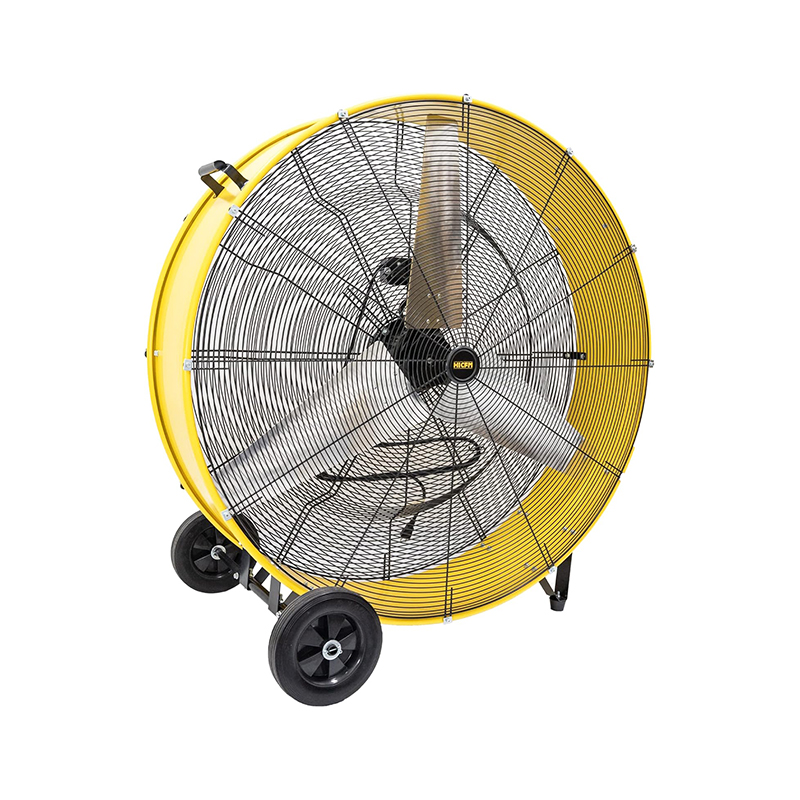
A Drum Fan sits very close to the ground. It utilizes a deep, cylindrical housing. We often call this housing a barrel. This shape creates a highly focused wind tunnel effect. It pushes massive volumes of air across vast distances. The deep barrel physically channels the air forward in a tight, aggressive cone.
Performance Strengths:
You get the absolute highest CFM per dollar spent.
Its low center of gravity keeps it highly stable.
It resists tipping easily, even in chaotic work zones.
Wheeled designs allow for relatively easy relocation despite the heavy physical weight.
They excel at drying wet floors quickly after deep cleanings.
Implementation Limitations:
These bulky units consume premium, valuable floor space.
They aggressively kick up ground-level dust and loose debris.
Pallets, heavy machinery, or low walls block their airflow instantly.
They require substantial empty space behind them to pull air efficiently.
Best Practice: Keep the rear intake grille at least three feet from any solid wall. This spacing ensures optimal air draw and prevents the motor from overheating.
High-velocity pedestal fans mount a powerful head on an adjustable vertical pole. Manufacturers usually anchor this pole to a heavy metal base. These units often feature helpful mechanical oscillation capabilities. This elevated design entirely changes how air moves through your facility.
Performance Strengths:
They easily bypass common floor-level obstructions and crowded aisles.
You can push air directly over high workbenches or tall inventory stacks.
The minimal floor footprint preserves your usable square footage.
Oscillation provides wider, sweeping coverage for a spread-out workforce.
You can adjust the vertical height to match specific worker stations.
Implementation Limitations:
A much higher center of gravity increases tip-over risks significantly.
Careless forklifts or heavy foot traffic can easily knock them down.
They generally deliver lower raw CFM than similarly sized barrel models.
The mechanical oscillation gears require occasional maintenance and lubrication.
Common Mistake: Do not place pedestal models directly at the corners of busy warehouse intersections. They easily become hidden collision hazards for moving vehicles.
Understanding how different features yield specific outcomes helps you buy smarter. Review the Industrial Cooling Evaluation Chart below to compare key operational metrics.
Industrial Cooling Evaluation Chart
| Evaluation Metric | Drum Models | Pedestal Models |
|---|---|---|
| Airflow Style | Broad, deep floor-level sweep | Elevated, sweeping, targeted delivery |
| Space Requirement | High (needs deep clearance) | Low (compact base footprint) |
| Obstacle Handling | Poor (easily blocked by ground items) | Excellent (blows smoothly over items) |
| Portability | Good (uses heavy-duty rubber wheels) | Fair (requires tilting and dragging) |
Assess your total square footage against your available vertical clearance. Narrow aisles heavily benefit from elevated pedestal units. They keep the walking paths completely clear for personnel. Conversely, wide-open loading docks desperately require the massive forward throw of a ground-level unit. You must map your permanent physical obstacles before buying anything. A fan cannot cool a worker if a stack of boxes blocks the wind.
We must acknowledge a harsh reality here. All high-velocity industrial fans run extremely loud. However, their specific sound profiles differ. A large Commercial Barrel Fan creates a deep, low-pitch hum. Smaller elevated blades produce a sharper, higher-pitch whir. Workers may require proper hearing protection when operating near these units. You should prioritize layout needs over noise reduction, as neither option operates quietly.
Always evaluate exterior housing materials carefully before purchasing. Steel construction vastly outperforms heavy-duty plastic in demanding commercial settings. Address the ease of cleaning your grilles and internal blades. Enclosed barrels naturally trap significantly more internal dust over time. You will need to dismantle them more frequently for thorough, deep cleaning. Open pedestal heads allow dust to pass through much easier.
Moving massive air volumes introduces unique workplace hazards. You must actively manage these physical risks to protect your teams and equipment.
Floor-sitting models naturally introduce thick power cables across active walkways. You must secure these loose cords using heavy-duty polyurethane cable protectors. Loose cables cause devastating workplace falls. Conversely, elevated bases create immediate tripping hazards if you place them poorly. Keep them tucked against structural columns or sturdy racks whenever possible.
Always verify strict OSHA and general workplace safety compliance. Ensure all metal grilles meet required finger-safe spacing standards. OSHA mandates specific guard spacing to prevent accidental contact. Industrial motors spin massive metal blades at incredibly high speeds. They can cause severe injuries if the protective guards fail or break.
Environmental factors heavily influence your safety strategy. Using a ground-level unit inside a dusty woodshop aerosolizes dangerous floor particulates. Workers will inhale this hazardous silica or sawdust quickly. You must pair high-velocity circulation with active, professional dust extraction systems in these dirty environments. Protect your team's respiratory health at all costs.
Making your final choice comes down to your specific spatial reality. We have outlined two common scenarios below to guide your thinking.
Scenario A: Auto Shops, Warehouses, and Open Gyms. We strongly recommend the drum model here. These massive spaces trap thick, heavy heat. The urgent need to aggressively cycle massive air volumes trumps all footprint concerns. You have the floor space available, so use it. Roll the unit near large open bay doors to pull fresh exterior air inside rapidly.
Scenario B: Crowded Workshops, Patios, and Assembly Lines. We highly recommend the pedestal fan for these tight environments. Your need to clear physical obstacles remains critical. You must target specific standing workstations without monopolizing valuable floor space. The oscillating head sweeps cool air across multiple workers continuously. You avoid blasting loose paperwork or lightweight materials off nearby desks.
Take these actionable steps before finalizing your purchase:
Measure the exact square footage of your intended placement area.
Identify any permanent floor-level obstacles blocking potential wind paths.
Check the manufacturer's verified CFM ratings carefully.
Ignore flashy marketing superlatives regarding wind speed.
Confirm the available electrical amperage on your intended wall circuit.
Neither high-velocity model proves universally superior in every single environment. Your ultimate choice hinges entirely on your unique spatial layout. You must weigh open floor space against tight, cluttered aisles. You must balance the need for targeted cooling against total volume turnover. Floor-level units dominate open spaces, while elevated units master crowded rooms.
We advise all buyers to prioritize durable, all-metal construction. Always look for fully enclosed, sealed motors. This specific motor design protects sensitive internal components against aggressive workplace dust. Following these guidelines ensures you secure a reliable, long-lasting cooling solution for your toughest environments.
A: We generally advise against using them inside standard homes. They produce overwhelming industrial decibel levels. Furthermore, their physical size dominates residential rooms. The massive CFM output easily blows loose items off tables and shelves. Stick to standard residential models for indoor household use.
A: Electricity consumption depends entirely on the motor's wattage, not the exterior housing shape. A 300-watt pedestal motor and a 300-watt barrel motor consume identical power. Always check the specific wattage rating on the manufacturer label to determine your expected energy costs.
A: First, measure the physical dimensions of the exterior cylindrical housing. Next, you must add at least three feet of empty space behind the unit. This required rear clearance ensures the motor can pull sufficient intake air without straining or overheating.
A: They carry a higher center of gravity, which naturally increases their tip-over risk. However, high-quality industrial models feature heavily weighted steel bases to counteract this specific issue. For maximum safety, always place them on completely flat surfaces and keep them away from forklift traffic.


