- All
- Product Name
- Product Keyword
- Product Model
- Product Summary
- Product Description
- Multi Field Search
Please Choose Your Language


Views: 0 Author: Site Editor Publish Time: 2026-07-02 Origin: Site


Managing heat stress, air stratification, and OSHA compliance presents a massive challenge in large industrial spaces. You need effective airflow across vast square footage without completely overhauling existing HVAC systems. Stagnant, hot air ruins worker productivity and creates severe safety risks on the warehouse floor. While many facilities struggle to cool specific zones efficiently, evaluating heavy-duty drum fans for targeted, high-velocity cooling provides a direct solution.
A reliable procurement decision requires matching motor types, drive mechanics, and airflow capacities directly to your exact facility conditions. You cannot simply default to the highest CFM available on the market. Precision matters when selecting industrial cooling equipment. This guide explores how you can evaluate fan specifications, understand drive mechanisms, and match equipment to your specific industrial environment. You will learn actionable steps to improve warehouse ventilation, ensure worker safety, and optimize your cooling investments effectively.
Industrial barrel fans are engineered for high-velocity spot cooling, making them ideal for loading docks, assembly lines, and high-heat zones.
Choosing between belt-drive and direct-drive configurations dictates both noise levels and ongoing maintenance requirements.
Matching motor enclosures (e.g., TEFC vs. ODP) to environmental hazards (dust, moisture) is critical to preventing premature equipment failure.
Effective deployment requires balancing CFM capabilities with localized noise restrictions and worker safety protocols.
Warehouse managers often invest heavily in High-Volume, Low-Speed (HVLS) ceiling fans. These giant fans excel at general air destratification. They mix warm ceiling air into cooler floor air slowly. However, HVLS fans fail to provide adequate spot cooling in localized high-heat zones. They also struggle in areas facing heavy cross-drafts. Open loading bays experience constant wind interference. Standard ceiling fans cannot overcome these competing air currents.
This situation highlights the distinct advantage of high-velocity spot cooling. A rugged Drum Fan delivers a highly concentrated, directional airstream. This powerful punch easily exceeds 100 feet in distance. It breaks through stagnant air columns effectively. Workers standing near hot machinery require rapid sweat evaporation to stay safe. Only a focused, high-velocity air column can provide this immediate evaporative cooling effect.
Facility layouts change constantly as inventory shifts. You must evaluate the need for rapid redeployment across the facility floor. Permanent wall or ceiling-mounted fixtures lack flexibility. They lock your ventilation strategy into a single layout. Heavy-duty portable units roll easily on industrial casters. You can move them directly to temporary work zones, seasonal packing lines, or newly established assembly stations. This mobility ensures your cooling equipment always serves the most critical areas on demand.
Selecting the right size requires accurate calculations. You must determine baseline CFM (Cubic Feet per Minute) requirements based on your specific workspace. Industry standards recommend calculating necessary air exchanges per hour (ACH). You base this on zone square footage and ceiling height. For localized cooling, you calculate the volume of the specific work zone rather than the entire building.
Follow these steps to determine your baseline CFM needs:
Measure the length, width, and height of the targeted cooling zone to find the total cubic volume.
Determine the required air changes per hour for your industry (typically 10-20 ACH for warehouses).
Multiply the cubic volume by the ACH target.
Divide this total by 60 to find the minimum CFM required.
However, maximum CFM does not equal effective cooling distance. You must understand velocity drop-off. Manufacturers often advertise impressive CFM numbers measured right at the blade. This air volume dissipates rapidly as it travels. You must evaluate the fan’s throw distance. Look for feet per minute (FPM) ratings at specific ranges. Human comfort typically requires an air velocity between 200 and 400 FPM. If a fan moves 20,000 CFM but the velocity drops below 200 FPM at twenty feet, it will not cool workers stationed further away.
Avoid over-specification when buying equipment. Deploying oversized fans in confined aisles causes severe diminishing returns. High-velocity air bouncing off narrow racking systems creates chaotic turbulence. It kicks up excessive dust and blows lightweight materials off workbenches. Oversized motors also waste significant energy. Match your airflow reach strictly to the dimensions of the target zone.
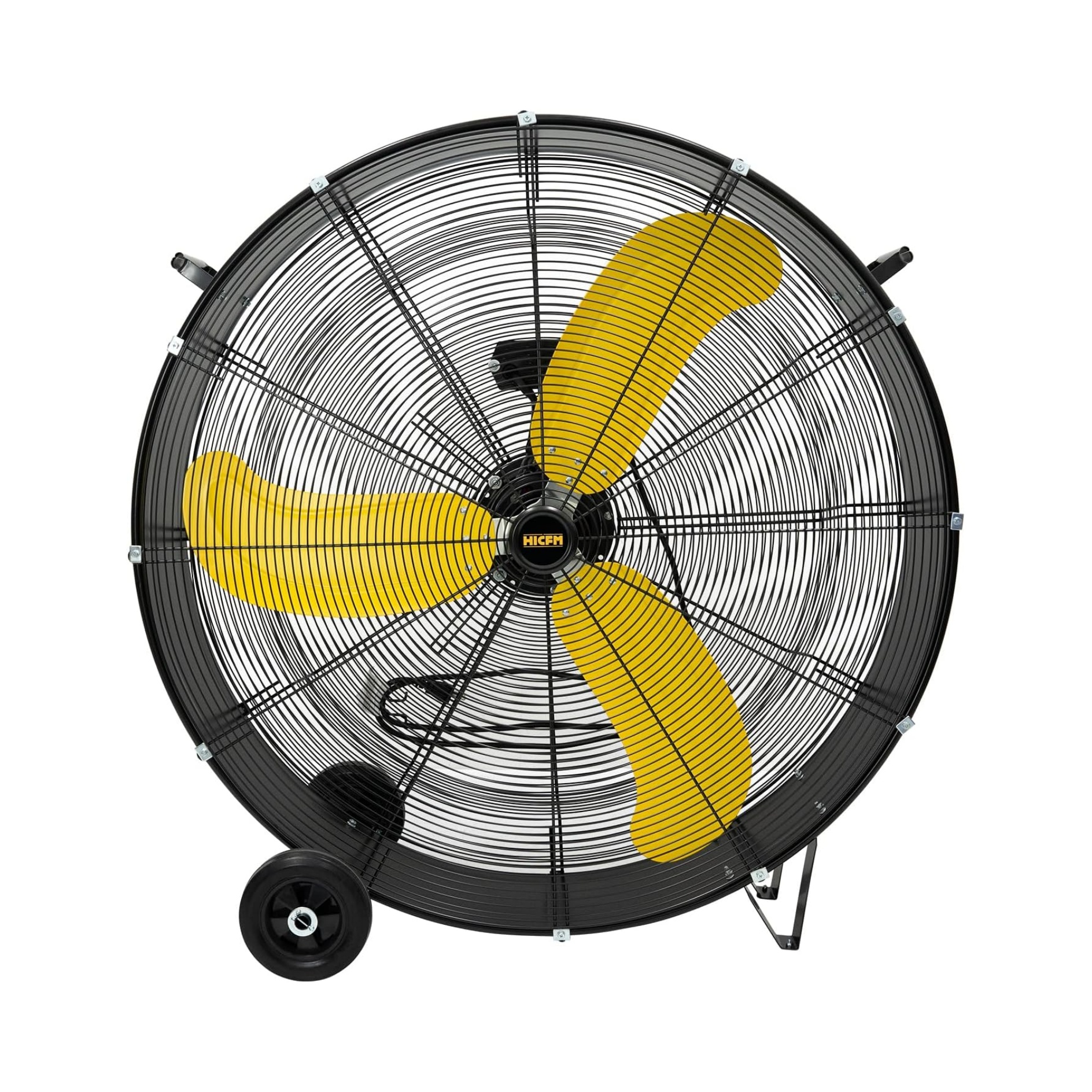
Understanding internal drive mechanics separates average buyers from procurement experts. Direct-drive mechanics mount the fan blade directly onto the motor shaft. The blade spins at the exact same RPM as the motor. This simple design offers distinct pros and cons.
Direct-drive units require minimal maintenance. They have fewer moving parts to inspect. They feature a more compact footprint and usually offer a lower initial purchase cost. However, the cons include significantly higher RPMs. Fast-spinning blades slice the air aggressively, leading to increased noise levels. The motor also absorbs direct torque and vibration from the blades. This direct stress can accelerate motor wear in extremely harsh environments.
Belt-drive mechanics operate differently. A pulley system connects the motor to the blade assembly. The motor spins rapidly, but the pulleys reduce the blade RPM. The pros of this setup include noticeably quieter operation. The slower, larger blades move massive columns of air efficiently. The motor also enjoys a longer lifespan because the belt absorbs starting torque and blade vibration. The primary cons involve maintenance overhead. The belt introduces friction points. It requires periodic tensioning and eventual belt replacements to prevent slipping.
Use a clear decision framework for your facility. Match direct-drive units to smaller, high-turnover areas where noise is less concerning. Use belt-drive units for continuous-use, noise-sensitive zones where worker communication remains critical.
| Feature | Direct-Drive Configuration | Belt-Drive Configuration |
|---|---|---|
| Maintenance Needs | Low (No belts or pulleys to adjust) | Moderate (Requires belt tensioning) |
| Noise Output | Higher (Faster blade RPM) | Lower (Slower, deeper blade rotation) |
| Motor Lifespan | Average (Absorbs direct vibration) | Extended (Belt absorbs shock and torque) |
| Ideal Application | Loading docks, temporary work zones | Assembly lines, continuous work areas |
Industrial environments destroy standard retail fans in weeks. You must match motor enclosures to your specific environmental hazards. Failing to do this guarantees premature equipment failure. Open Drip-Proof (ODP) motors represent the cost-effective standard for basic industrial spaces. ODP motors feature vents in their casing. Ambient air flows directly over the internal windings to cool the motor. They work perfectly for clean, indoor warehouse environments experiencing standard humidity. If your facility remains relatively dust-free, ODP motors offer excellent value.
Conversely, Totally Enclosed Fan-Cooled (TEFC) motors are a mandatory upgrade for harsh locations. A TEFC motor seals the internal electrical components completely away from outside air. A secondary external fan blows air over the ribbed outer casing to cool the unit. You must specify TEFC motors for facilities handling airborne particulates, heavy sawdust, or corrosive fumes. They also survive wash-down requirements in food processing plants. Buying an ODP motor for a dusty woodworking shop will result in immediate clogging and motor burnout.
An authentic Industrial Barrel Fan pairs these rugged motors with equally durable housing. Assess the material specifications carefully. Look for heavy-gauge steel barrels measuring 20-gauge or thicker. Flimsy aluminum housings dent easily when bumped by forklifts. Ensure the manufacturer uses powder-coated finishes rather than basic paint. Powder coating provides superior rust resistance against high humidity. Finally, verify OSHA-compliant close-mesh fan guards. The guard spacing must be small enough to prevent workers from accidentally pushing fingers or tools into the spinning blades.
Deploying high-velocity cooling equipment introduces new facility risks. You must plan for acoustic considerations immediately. Factor decibel (dB) ratings into your daily operations. A fan pushing 85 dB will drown out worker communication. It may also trigger mandatory OSHA hearing protection requirements. Review your internal safety protocols before placing noisy equipment near active assembly lines. Always verify the decibel rating at a standardized distance, typically 10 feet from the fan.
Strategic placement maximizes cooling while minimizing disruption. Map your existing airflow patterns carefully. Avoid cross-draft conflicts with existing overhead ventilation systems. Placing floor fans pointing in opposing directions creates dead zones where air simply stops moving. You must also avoid disrupting light manufacturing processes. Pointing a high-velocity airstream at a precision scale, welding station, or paper packaging line will ruin production efficiency.
Map the prevailing drafts: Align your fans to push air in the same direction as your natural cross-breezes.
Clear the intake zone: Leave at least three feet of empty space behind the fan to ensure maximum air draw.
Protect sensitive tasks: Angle airflow slightly upward to cool workers without blowing components off workbenches.
Establish dedicated parking: Paint floor markings to designate where portable units should sit to avoid blocking forklift traffic.
Mitigating safety hazards requires strict attention to detail. Heavy-duty power cords present severe tripping risks. Route cords along structural columns or cover them using industrial floor ramps. High-visibility yellow cords help workers spot hazards easily. Additionally, ensure the locking mechanisms on caster wheels use industrial-grade materials. Polyurethane wheels with steel locking brakes hold heavy units securely in place. Cheap plastic casters will vibrate loose, causing the running fan to roll dangerously across the floor.
Finalizing your equipment choice requires looking beyond the initial purchase price. Energy consumption plays a massive role in long-term operations. Balancing high-velocity performance against continuous-draw energy costs ensures efficient facility management. Look closely at the CFM-per-watt ratio. Highly efficient motors generate maximum airflow while drawing fewer amps. This efficiency matters deeply when you deploy dozens of units across a massive distribution center. Running inefficient motors 24/7 during summer months spikes electrical bills aggressively.
Perform a warranty reality check before signing any purchase orders. Understand what differentiates a basic commercial warranty from a true industrial warranty. Retail-grade fans often offer a limited one-year warranty covering basic defects. Industrial manufacturers stand behind their equipment longer. Look for comprehensive parts coverage spanning three to five years. Ensure the warranty covers continuous 24/7 operation. Some warranties void automatically if you run the equipment continuously rather than intermittently.
Develop strict shortlisting criteria before contacting vendors. Finalize your internal requirements first. Document the specific motor type you need (TEFC or ODP). Note the preferred drive configuration (belt or direct). Establish your specific CFM minimums based on your earlier ACH calculations. Handing these exact specifications to a vendor streamlines the quoting process. It also prevents salespeople from upselling you on unnecessary features or oversized units. Consolidate your final list and request bulk pricing to maximize your procurement budget.
Selecting the right high-velocity cooling equipment demands careful evaluation of your facility's unique environment. You must balance environmental demands, your team's maintenance capacity, and precise airflow requirements. Defaulting to the cheapest option or the highest CFM rating often leads to costly inefficiencies and premature equipment failure. Proper sizing, matched motor enclosures, and strategic placement guarantee optimal cooling performance.
To move forward effectively, audit the specific warehouse zones requiring immediate spot cooling. Measure the square footage and evaluate the dust levels in those areas. Check your available electrical infrastructure to ensure your circuits can handle the continuous amp draw of heavy-duty motors. Finally, consult directly with an industrial ventilation specialist using your documented specifications to finalize your models and secure bulk procurement pricing.
A: Calculate the volume of your targeted cooling zone (Length x Width x Height). Multiply this volume by your required Air Changes per Hour (typically 10 to 20 for industrial spot cooling). Divide the total by 60. This formula provides the baseline CFM required to ventilate that specific area effectively.
A: Standard floor fans use shallow cages and smaller motors for general air circulation. A drum model features deep, heavy-gauge barrel housing. This aerodynamic barrel creates a directional tunnel, allowing the heavy-duty motor to throw a concentrated column of air over much longer distances.
A: Belt-drive units typically require a brief visual inspection every three months. You should check belt tension and look for fraying edges. Expect to replace the drive belt every one to two years, depending on whether the unit runs continuously or seasonally.
A: Only specific models survive wet environments. You must select a unit featuring a Totally Enclosed Fan-Cooled (TEFC) motor. Additionally, the equipment must carry an appropriate NEMA or IP wash-down rating to ensure moisture cannot penetrate the electrical housing and cause a short circuit.


