- All
- Product Name
- Product Keyword
- Product Model
- Product Summary
- Product Description
- Multi Field Search
Please Choose Your Language


Views: 0 Author: Site Editor Publish Time: 2026-09-15 Origin: Site


Standard residential fans fail quickly in rigorous industrial, warehouse, or commercial environments. You often see them burned out, vibrating loudly, or dangerously unstable on the shop floor. This frequent failure rate disrupts work. It also creates significant safety hazards for employees. A true heavy duty pedestal fan must deliver continuous, high-velocity airflow. It must operate daily without thermal failure, tipping risks, or excessive maintenance overhead. You need equipment built to withstand extreme conditions. This article provides a strict, specification-driven evaluation framework. We will help you distinguish genuine commercial-grade equipment from consumer fans dressed in industrial aesthetics. You will learn exactly what to look for in motors, airflow metrics, structural integrity, and safety compliance. By the end, you can make an informed, confident purchase decision.
Motor housing dictates lifespan: Insist on thermally protected, fully enclosed motors for dusty or continuous-use environments.
CFM determines real-world performance, not just blade size: Match the airflow volume to the square footage of the cooling zone.
Safety compliance is non-negotiable: Look for OSHA-compliant grill spacing and heavy-gauge, grounded power cords.
Weight equals stability: True industrial fans require a cast-iron or heavy steel base to counteract the torque of high-velocity operation.
The motor serves as the heart of any cooling equipment. Its design directly determines how long the unit will survive in harsh conditions. Many buyers overlook the motor housing, but this choice dictates the lifespan of the equipment.
You will typically encounter two main types of motor enclosures in commercial fans. Totally Enclosed Fan Cooled (TEFC) motors seal the internal electrical components away from outside air. A secondary external fan blows air over the casing to cool it. TEFC motors are mandatory for workshops handling woodworking, metalworking, or heavy airborne debris. The sealed design prevents conductive dust from shorting the electrical components. Open Drip Proof (ODP) motors allow ambient air to flow directly through the internal windings. ODP motors may suffice for clean commercial spaces, but they fail rapidly in dusty environments.
Table: Motor Enclosure Comparison
| Enclosure Type | Design Mechanism | Ideal Environment | Vulnerability |
|---|---|---|---|
| TEFC | Fully sealed internal casing | Dusty workshops, garages | Retains more internal heat |
| ODP | Vented casing for direct airflow | Clean retail stores, gyms | Dust and debris buildup |
Thermal overload protection acts as a critical safety baseline. High-velocity fans generate intense heat during long shifts. If the motor gets too hot, the insulation around the wiring melts. This creates a severe fire hazard. Auto-reset thermal switches monitor internal temperatures constantly. When temperatures exceed safe limits, the switch severs the electrical connection. The motor stops entirely. Once the unit cools down, the switch resets automatically. You should never buy a fan lacking this basic safety feature.
Manufacturers often cut corners by using aluminum wire instead of copper wire inside the motor. Aluminum costs less, but it carries significant drawbacks. It expands and contracts heavily during heating and cooling cycles. This movement causes micro-cracks in the wire over time. You must advise your procurement team to check for 100% copper motor windings. Copper offers vastly superior heat dissipation. It conducts electricity better and guarantees a longer operational lifespan.
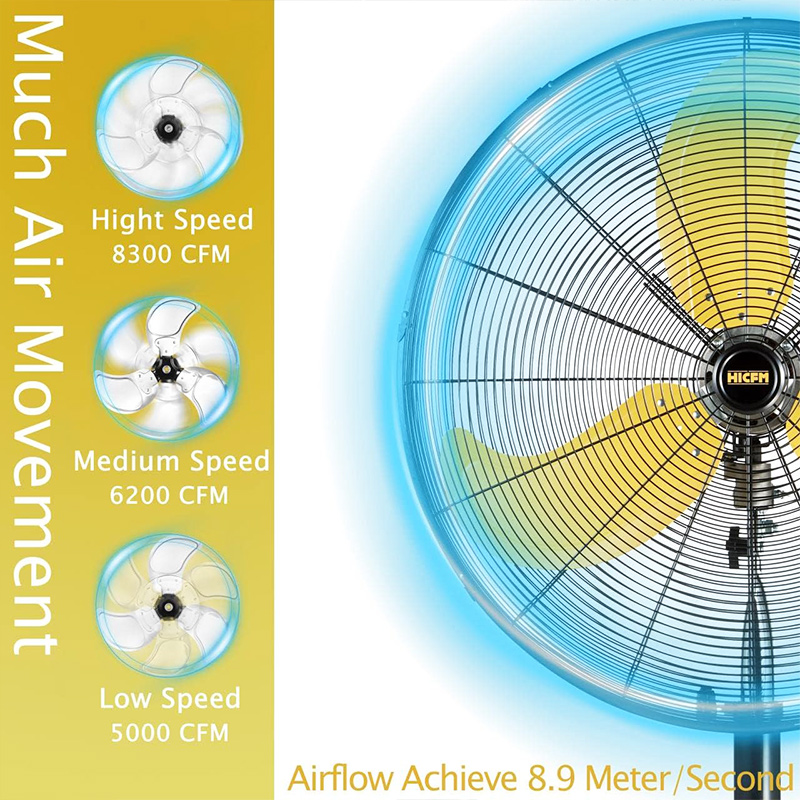
Bigger blades do not always guarantee better cooling. You must evaluate the actual volume of air the fan moves. This volume dictates how effectively you can cool a specific zone.
Cubic Feet per Minute (CFM) measures the exact volume of air moving through the fan every sixty seconds. You must evaluate CFM ratings against the specific cooling zone you need to manage. Manufacturers sometimes exaggerate these numbers using idealized testing conditions. Always look for independent lab verifications or AMCA (Air Movement and Control Association) certifications. High CFM numbers look great on paper. However, they only matter if the fan can push that air across the room.
Chart: Recommended CFM by Cooling Zone Size
| Cooling Zone Size | Application Example | Minimum Recommended CFM |
|---|---|---|
| Small (Up to 500 sq. ft.) | Single workstation, auto bay | 3,000 - 5,000 CFM |
| Medium (500 - 1,500 sq. ft.) | Loading docks, small garages | 5,000 - 8,000 CFM |
| Large (1,500+ sq. ft.) | Warehouse floors, barns | 8,000+ CFM |
Selecting the right size prevents wasted energy and poor performance. Position a 24 inch stand fan for targeted cooling at individual workstations. These models excel in tight loading docks or crowded auto bays where space is limited. They provide intense, concentrated airflow directly onto the worker. Conversely, position a 30 inch industrial fan for broad air circulation across open warehouse floors. Large agricultural facilities also benefit from this wider air dispersion. The larger blades sweep more air per rotation, changing the ambient temperature of massive rooms more effectively.
Blade RPM (Revolutions Per Minute) and blade pitch determine the actual distance the air is thrown. A fan might have a high CFM rating but a shallow blade pitch. This means it moves a lot of air right next to the grill, but the breeze dies a few feet away. A steeper blade pitch paired with high RPMs creates a tight, high-velocity air column. This column cuts through stagnant room air, throwing the breeze 50 feet or more. Always check the velocity profile if you need to cool workers positioned far away from the unit.
Industrial environments punish weak equipment. Forklifts bump into things, and vibrations loosen cheap bolts. A fan's structural integrity dictates its physical safety on the floor.
High-velocity motors generate immense torque. This twisting force naturally tries to spin the entire fan assembly backward. A heavy, low-center-of-gravity base is required to prevent tipping in high-traffic commercial zones. Solid steel or cast iron bases anchor the unit firmly to the concrete floor. Lighter plastic or thin stamped-metal bases vibrate wildly. They "walk" across the floor during operation. A heavy base ensures the unit stays exactly where you put it.
Height adjustment mechanisms represent a common failure point. When evaluating the hardware of an adjustable pedestal fan, inspect the locking collars carefully. Cheap plastic collars crack easily under constant motor vibration. Once they crack, the fan head slides down the pole. You must demand threaded metal locking collars. Steel extension poles provide the necessary rigidity to hold a heavy motor 6 feet in the air. The tilt mechanism also requires heavy-duty steel ratchets to hold the fan angle securely.
Blades: Specify powder-coated steel or industrial-grade aluminum blades over plastic. Plastic warps under high heat and cracks if struck by flying debris. Metal blades maintain their aerodynamic pitch perfectly over years of use.
Grills: Heavy-gauge steel wire forms the best protective grills. Powder coating adds a vital layer of protection against warehouse humidity.
Corrosion Resistance: Bare metal rusts quickly in agricultural settings. Powder-coated finishes resist warping, chipping, and corrosion much better than standard paint.
Workplace safety relies heavily on the physical design of your equipment. Non-compliant fans expose your business to severe liabilities and risk worker injury.
Industrial fans spin fast enough to sever fingers. You must highlight OSHA standard 1910.212(a)(5) during your evaluation process. This standard strictly requires fan guards to have openings no larger than one-half inch. This rule applies if the fan operates within seven feet of the floor. Standard residential fans usually fail this test, featuring wide grill gaps. Concentric steel rings placed tightly together prevent loose clothing, tools, or hands from contacting the spinning blades.
Always check for independent laboratory certifications. UL (Underwriters Laboratories) or ETL (Intertek) marks prove the electrical components passed rigorous safety tests. The power cord itself requires scrutiny. Insist on heavy-duty 3-prong grounded plugs. Look for SJT-type (Hard Service, Thermoplastic) thick power cords. These cords resist crushing damage when workers accidentally roll heavy carts over them on the warehouse floor. Thin residential cords fray easily, creating shock hazards.
Facilities often face the common operational risk of leaving fans on overnight to dry floors or exhaust fumes. A genuine commercial cooling fan features a continuous-duty rated motor. These motors can run 24 hours a day, 7 days a week without overheating. Proper thermal relays keep them safe for continuous operation. Residential models use intermittent-duty motors. Running them continuously melts their internal components. Confirm the duty rating before authorizing overnight usage.
Understanding the day-to-day realities of running industrial equipment prevents unpleasant surprises after purchase. You must account for sound output, upkeep routines, and support terms.
Buyers need transparent expectations regarding sound output. High-velocity industrial fans are loud. They often produce 60 to 75+ decibels (dB) on their highest settings. This sound level resembles a busy restaurant or a vacuum cleaner running nearby. We frame this as an acceptable trade-off for moving massive air volumes. However, you must flag this as a crucial consideration for noise-sensitive commercial spaces. Retail stores, churches, or office environments might find 75 dB disruptive. Review the lowest speed settings to ensure the fan can operate quietly when required.
Industrial equipment requires periodic upkeep to survive. You should check for accessible grease or lubrication ports on the motor bearings. These ports, often called Zerk fittings, allow maintenance teams to inject fresh grease directly into the moving parts. This simple maintenance routine extends the fan's lifecycle dramatically. Sealed bearings offer convenience, but they cannot be re-lubricated once they dry out. Clean the grills regularly, as dust buildup restricts airflow and forces the motor to work harder.
The fine print on a warranty tells you exactly how much confidence the manufacturer has in their product. Advise buyers to look for a minimum 1-to-2-year commercial warranty. Many consumers mistakenly buy retail fans for their warehouses. They later discover consumer warranties are often voided instantly if the fan is used in a commercial setting. Commercial warranties guarantee prompt replacement parts, robust technical support, and protection against premature motor failure.
Finding the right heavy-duty fan requires strict attention to engineering details. You should summarize your evaluation funnel using a clear shortlisting logic. First, filter your options by motor type and safety features, ensuring TEFC housings and OSHA compliance. Second, filter by CFM and physical size to guarantee adequate airflow for your space. Third, filter by build materials, rejecting plastic locking collars and flimsy bases. By following this funnel, you eliminate weak products immediately. As a next-step action, encourage buyers to measure their floor space accurately. Assess the ambient dust levels of your specific environment. Finally, verify your local OSHA requirements before issuing a purchase order to guarantee total workplace safety.
A: Yes, provided it has thermal overload protection and a continuous-duty rated motor. These features prevent catastrophic overheating during long shifts. Always ensure the intake vents remain clear of dust or physical obstructions to maintain proper airflow.
A: Commercial fans use heavy-gauge metal, higher RPM motors, thicker power cords, and OSHA-compliant guards. They are built specifically for continuous use in harsh conditions. Residential fans use plastic parts, intermittent-duty motors, and are designed only for light, temporary use.
A: Generally, 4,000 to 6,000 CFM is sufficient to cycle the air in a standard garage effectively. This airflow volume is typically found in a 24-inch model or a high-velocity 20-inch fan, providing strong cooling without overwhelming the small space.


