- All
- Product Name
- Product Keyword
- Product Model
- Product Summary
- Product Description
- Multi Field Search
Please Choose Your Language


Views: 0 Author: Site Editor Publish Time: 2026-08-21 Origin: Site


Proper cooling transforms a hot warehouse into a highly productive workspace. When facility managers tackle excessive heat, many simply buy the biggest equipment available. This approach often backfires quickly. Selecting the wrong size creates stagnant dead air zones. It wastes massive amounts of energy. It also introduces serious safety hazards. Optimal sizing relies heavily on facility geometry, obstacle layouts, and specific cooling goals. You cannot just guess the equipment diameter. It requires a precise calculation based directly on square footage and ceiling height. In this article, you will learn how to evaluate your space correctly. We will break down airflow mechanics, structural clearance limits, and core equipment categories. You will discover exactly how to map out racking obstructions properly. Let us build a reliable evaluation framework. This framework ensures your entire facility remains safe, fully compliant, and comfortably cool all year round.
Fan diameter must correspond directly to ceiling height and floor-level clearance; oversized fans in constrained spaces create turbulent, inefficient airflow.
Total CFM (Cubic Feet per Minute) determines cooling capacity, but air velocity distribution dictates employee comfort and condensation control.
Directional floor fans (like a 36 inch drum fan or 60 inch barrel fan) serve distinct spot-cooling purposes compared to the widespread ambient control of HVLS (High-Volume Low-Speed) ceiling fans.
Structural load limits, fire suppression system clearances, and electrical phases are primary disqualifiers during the procurement process.
Industrial spaces require highly precise environmental control. You must deeply understand how air moves through a vast structure. A single large industrial fan pushes air downward in a massive cylindrical column. When this air hits the concrete floor, it moves outward in all directions. This creates a strong horizontal jet stream. Engineers call this phenomenon the Coandă effect or a floor jet. It sweeps across the ground gently to cool your workers.
Industry standards rely on a general 1-to-5 ratio for coverage. A 24-foot fan typically covers a 120-foot diameter area under ideal conditions. However, perfect conditions rarely exist in real-world warehouses. You must evaluate your exact spatial geometry first. A simple tape measure will not suffice.
Ceiling height directly dictates your minimum and maximum equipment size. Overhead installations require very specific vertical clearances. You generally need at least 10 to 15 feet of clearance above the floor. If the blades spin too low, they threaten employee safety directly. They also create harsh drafts instead of gentle breezes.
Extreme ceiling heights completely change the airflow math. Facilities featuring 40-foot ceilings struggle to push air down to the floor. In these towering spaces, you need much wider diameters. Larger blades capture more air volume per rotation. This ensures the downward air jet maintains enough momentum. It must reach ground-level workers before dissipating harmlessly into the rafters.
Obstructions instantly ruin perfect airflow maps. Racking systems break horizontal wind currents effectively. Heavy machinery deflects moving air upwards prematurely. Solid partition walls create highly isolated microclimates. You must map these layout obstructions carefully before ordering anything.
Consider these common mistakes during your initial facility assessment:
Ignoring dense pallet racks: Fully loaded warehouse racks block horizontal air jets almost completely.
Overlooking active overhead cranes: Bridge cranes limit your usable ceiling installation space heavily.
Assuming empty floor space: Equipment layouts change over time. Plan for future operational setups.
Forgetting pitched roofs: Sloped ceilings require specialized drop tubes and angled mounting brackets.
When pallet racking blocks air entirely, one massive unit fails. You should install multiple smaller units instead. A networked array of 12-foot models provides significantly better coverage than one blocked 24-foot model. The moving air navigates narrow aisles much more effectively. This strategic placement ensures total facility comfort.
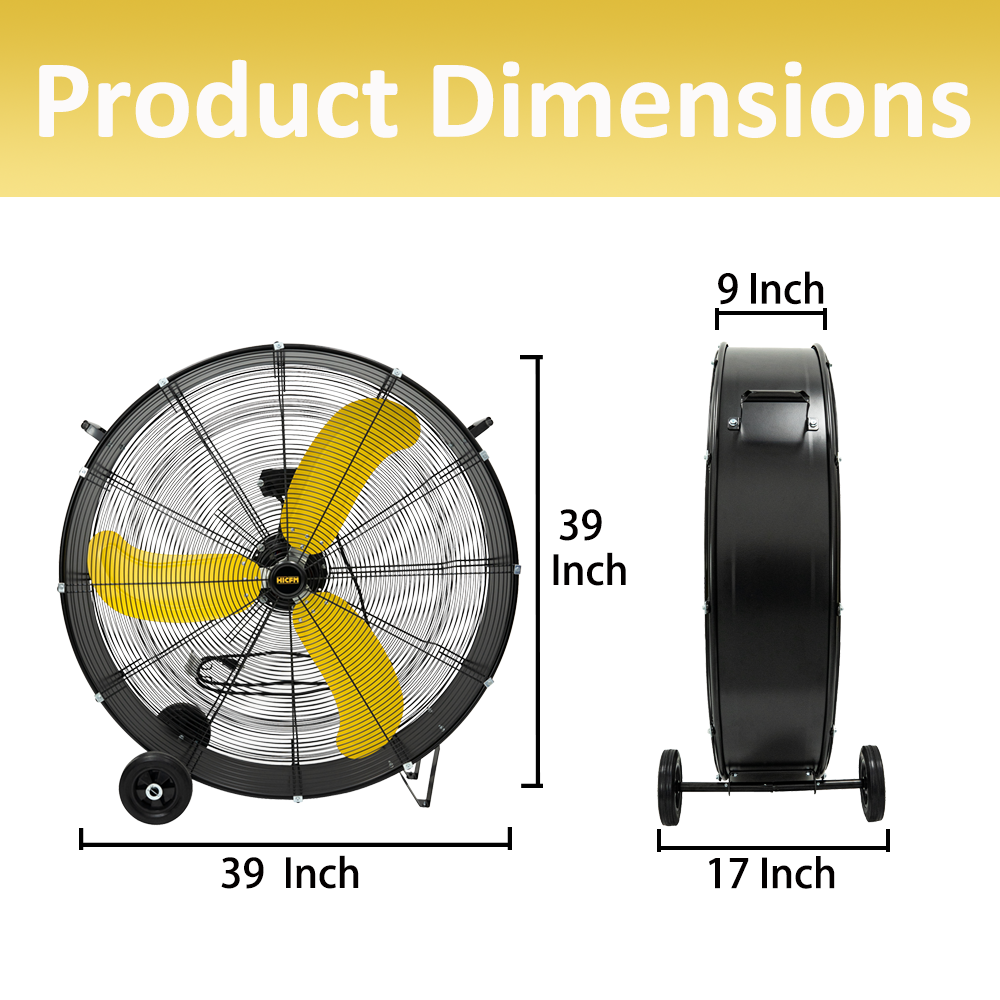
Facility managers must constantly choose between overhead air distribution and targeted ground cooling. Each equipment category solves very different environmental challenges. You must match the proper tool to the specific thermal problem.
Overhead HVLS units range from 12 to 24 feet in diameter. They excel at broad industrial ventilation across massive square footage. During summer, they create a continuous, gentle evaporative cooling effect. Workers feel up to 10 degrees cooler on their exposed skin. During winter, they perform essential heat destratification. They push trapped warm air down from the ceiling rafters. This vital process equalizes building temperatures rapidly.
However, HVLS units carry strict installation limitations. They require exceptionally high structural ceilings. They demand permanent hardwiring into the main building grid. You cannot simply move them once installed. They also conflict heavily with complex ceiling layouts.
High airflow floor and directional fans offer vital operational alternatives. They deliver concentrated, high-velocity air right where workers need it most. They bypass annoying ceiling constraints entirely.
Targeted Spot Cooling: A 36 inch drum fan works perfectly for specific isolated workstations. You can easily reposition it across the busy shop floor. It thrives in bustling loading docks and areas featuring severe spatial constraints. Maintenance teams absolutely love their rugged mobility. You plug them in and get instant relief.
Heavy-Duty Localized Cooling: A 60 inch barrel fan beautifully bridges the gap between spot cooling and wide-area coverage. It moves massive amounts of air horizontally across the concrete. You should use this when overhead ceiling installations remain totally impossible. Facilities utilizing active overhead cranes rely heavily on this exact size. It avoids dangerous overhead collisions entirely while covering assembly lines effectively.
Most modern, well-designed facilities utilize strategic hybrid approaches. They combine overhead HVLS technology for general ambient temperature control. Then, they cleverly deploy heavy-duty directional floor models for localized heat-generating machinery. This smart dual strategy eliminates dead air zones completely. It maximizes cooling exactly where your employees work the hardest.
You must rigorously evaluate specific performance metrics before purchasing expensive equipment. Two crucial numbers matter most during your selection process: Cubic Feet per Minute (CFM) and feet per minute (FPM).
CFM measures raw volumetric capacity. It tells you exactly how much air the equipment moves. Industrial spaces require specific air exchanges per hour (ACH). Welding shops require higher ACH than general storage warehouses. You can calculate your required CFM easily. First, determine your total room volume by multiplying length, width, and height. Next, multiply this exact volume by your target ACH. Finally, divide by 60.
Formula baseline: Required CFM = (Room Volume × Target ACH) / 60
This strict baseline ensures adequate ventilation. However, CFM alone does not guarantee actual human comfort. Air velocity dictates the actual perceived cooling effect. FPM measures sheer wind speed. It determines exactly how moving air feels on human skin.
For optimal worker comfort, target 2 to 3 mph at floor level. Higher velocities blow critical paperwork away rapidly. They constantly irritate your workers. Lower velocities completely fail to evaporate human sweat efficiently. You must study the specific velocity profiles provided by manufacturers. A unit might boast massive CFM figures but deliver extremely poor ground-level velocity distribution.
Motor efficiency heavily drives modern equipment performance. Traditional ventilation systems use standard AC induction motors. Newer, advanced systems utilize Permanent Magnet Synchronous Motors (PMSM).
PMSM technology effectively eliminates internal gear friction. It runs significantly cooler than traditional AC counterparts. This core temperature drop extends overall operational lifespans dramatically. The electronic commutation reduces total energy draw naturally. Highly efficient motors simply consume much less electrical power to generate the exact same CFM.
Motor Efficiency Comparison: AC vs. PMSM
| Feature | AC Induction Motor | PMSM (Permanent Magnet) |
|---|---|---|
| Energy Consumption | Higher base electrical draw | Highly efficient power usage |
| Operating Temperature | Generates considerable internal heat | Runs significantly cooler under load |
| Physical Weight | Heavy and bulky to mount | Lightweight and compact profile |
| Maintenance Needs | Requires regular lubrication intervals | Virtually maintenance-free design |
| Noise Level | Noticeable mechanical humming | Whisper-quiet continuous operation |
You must weigh these crucial technical differences carefully. Efficient motors reduce your facility's environmental impact heavily. They support modern green building certification standards seamlessly. They provide superior torque at much lower operating speeds.
Purchasing the right equipment only solves half the facility problem. Installation introduces highly complex structural and regulatory challenges. You must proactively mitigate these installation risks early.
Structural integrity remains your absolute primary concern. A heavy-duty high airflow fan demands exceptionally robust mounting points. You cannot simply bolt it anywhere. You must evaluate rotational torque, static weight, and dynamic weight thoroughly.
Static weight refers strictly to the inactive unit itself. Dynamic weight accounts for massive operational forces. When huge blades spin, they create powerful, continuous torque. This twisting force deeply stresses Z-purlins and I-beams. Always consult a licensed structural engineer before mounting large equipment. They will verify beam load capacities accurately. They prevent catastrophic structural failures.
Fire safety compliance strictly governs all equipment placements. The National Fire Protection Association (NFPA) sets crystal clear guidelines. Fan blades absolutely cannot interfere with building fire suppression systems.
You must maintain specific vertical clearances below ceiling sprinkler heads. If massive blades sit too close, they severely disrupt water distribution patterns. A facility fire could spread incredibly quickly. NFPA 13 dictates maximum allowable fan diameters and minimum distances from sprinklers. Local fire marshals enforce these crucial codes rigorously. You fail inspections instantly if you ignore them.
Electrical infrastructure realities often disqualify certain attractive models. Large industrial units require substantial, clean power. They typically demand 3-phase power setups. Older manufacturing facilities might only have single-phase power available. Upgrading electrical panels requires extensive planning and scheduling.
Modern installations routinely utilize Variable Frequency Drives (VFDs). These smart controllers manage motor speeds precisely. They eliminate massive, dangerous power spikes during system startup. Your new VFD must seamlessly integrate into your existing Building Management System (BMS). This specific integration allows automated climate control scheduling. Check software compatibility before finalizing your massive order.
You need a highly rigorous shortlisting process to finalize your choice. Do not rely entirely on glossy marketing brochures. Follow a proven, strict evaluation framework.
Step 1: Conduct the Site Audit
Verify your physical facility dimensions meticulously. Measure exact aisle widths, ceiling slopes, and structural beams. Check your voltage availability at the exact planned installation spot. Confirm load limits on every single mounting point. Document all physical obstructions carefully. Record the locations of lighting fixtures to prevent irritating strobe effects.
Step 2: Compare Advanced Airflow Mapping
Never accept generic square-footage claims from eager sales teams. Demand 3D airflow simulations from your shortlisted vendors. Engineers call this computational fluid dynamics (CFD). CFD modeling visualizes exactly how air will move in your specific space. It accounts precisely for your loaded racks, solid walls, and heavy machinery. This eliminates all airflow guesswork completely.
Step 3: Evaluate Warranties and Service Networks
Review comprehensive warranty documents very closely. Separate mechanical warranties from electrical warranties carefully. Manufacturers often generously cover metal blades for a decade. However, they might cover electronics for only three years. Furthermore, actively investigate local service networks. You strictly need certified installers available nearby. Improper installation directly voids manufacturer warranties instantly.
Optimizing industrial airflow requires precise engineering and careful planning. The best fan size balances raw CFM requirements, ceiling constraints, and floor layouts perfectly. You must strictly evaluate spatial geometry before analyzing motor specifications. Specific spot cooling demands mobile, directional equipment. Broad temperature destratification demands powerful overhead solutions. Do not let outdated sizing methods compromise your employee safety or operational comfort.
We highly recommend initiating a professional site survey immediately. Request customized 3D airflow modeling from your carefully shortlisted manufacturers. Always verify structural load limits and fire code compliance locally. Lock in exact engineering specifications before you commit any capital expenditure. Informed decisions consistently build safer, more comfortable facilities.
A: A high airflow directional fan pushes air at high speeds horizontally. They are perfect for rapid spot cooling in specific workstations. An HVLS (High-Volume Low-Speed) ceiling fan rotates slowly overhead. It moves massive volumes of air downwards. This creates a gentle, continuous breeze for broad ambient temperature control.
A: No. They serve entirely different purposes. A barrel unit provides powerful, horizontal spot cooling for concentrated areas. It works beautifully where ceilings are completely obstructed. Overhead units provide vertical air movement across massive square footage. One cannot perfectly replicate the physics of the other.
A: Warm air naturally rises quickly to the ceiling. This leaves floor-level employees freezing. Large overhead units run in reverse or at extremely low speeds. They gently push this trapped, heated air back down to the ground. This process equalizes building temperatures effectively.
A: Industry baselines suggest a 24-foot unit covers a 120-foot diameter area. This equates roughly to 11,000 square feet. However, this assumes a perfectly empty room. Racking systems, machinery, and walls significantly reduce this theoretical maximum. Always use computational fluid dynamics software to map realistic coverage.


