- All
- Product Name
- Product Keyword
- Product Model
- Product Summary
- Product Description
- Multi Field Search
Please Choose Your Language


Views: 0 Author: Site Editor Publish Time: 2026-08-13 Origin: Site


Warehouses consistently struggle against intense heat stratification and stagnant air. Local heat zones frequently form near busy loading docks or heavy machinery areas. These sweltering environments severely degrade worker safety and daily productivity. Addressing these harsh conditions demands targeted, aggressive air movement. Broad climate control often relies on whole-building HVAC systems. However, an industrial drum fan remains the absolute standard for immediate, localized cooling. These heavy-duty units push massive air volumes exactly where your team operates.
Selecting the right unit requires looking past flashy marketing claims. You must rigorously evaluate objective metrics like CFM capacity, motor drive mechanics, and environmental ratings. In this guide, you will learn how to match fan specifications to your exact spatial layout. We will explore essential features to ensure you select equipment optimized for powerful airflow, strict safety compliance, and maximum longevity.
Purpose: Drum fans excel at directional spot-cooling, not whole-facility temperature reduction (which requires HVAC or HVLS systems).
Capacity sizing: Match Cubic Feet per Minute (CFM) output to the specific square footage and required air exchange rate of the targeted work zone.
Drive types: Direct-drive motors offer lower maintenance, while belt-drive motors provide quieter operation for massive air volumes.
Compliance: Warehouse environments require OSHA-compliant grilles and appropriate Ingress Protection (IP) ratings for dust and moisture.
Large industrial ceiling fans, known as HVLS systems, focus on general destratification across vast spaces. They slowly mix upper and lower air layers to stabilize building temperatures. Conversely, drum fans serve a highly specific operational purpose. They deliver targeted, high-velocity airflow directly into isolated zones. You deploy them to actively cool workers stationed at loading docks, fast-paced assembly lines, or heavy trailer unloading bays.
The distinctive barrel design offers unmatched airflow penetration. The cylindrical housing naturally channels moving air into a tight, focused column. This aerodynamic shape pushes strong breezes deep into difficult operational spaces. You can effectively drive fresh air down long, narrow storage aisles. You can also force cooling gusts straight into enclosed, sweltering truck trailers during intense summer loading cycles.
Facility managers heavily favor these units due to their exceptional cost-to-implementation ratio. Drum fans operate as simple plug-and-play devices. They entirely bypass the complex structural engineering needed for heavy ceiling fans. You avoid expensive installation downtime and electrical permitting delays. Simply position the unit, plug it into a standard outlet, and instantly cool your active workforce.
Mastering basic drum fan selection requires a solid grasp of technical specifications. You must align the machine's capabilities to your exact environmental demands.
CFM measures the volume of air a fan moves every sixty seconds. To calculate your baseline requirement, you use a simple formula. Divide your targeted zone's total area volume by your desired air exchange rate. This calculation provides your minimum required CFM. Do not blindly purchase the highest capacity model available. Excessive velocity causes severe operational headaches. A high velocity barrel fan pushing too much air easily disrupts lightweight materials. It can scatter packing slips, blow away lightweight cardboard, or damage sensitive assembly components. Always choose a capacity perfectly tailored to the specific warehouse zone.
Motor configuration heavily dictates performance and maintenance schedules. You must choose between two primary mechanical designs based on your daily operational needs.
Direct-drive units attach the fan blades directly to the motor shaft. They feature a smaller footprint and carry a lower initial purchase cost. Facility teams appreciate them because they require zero belt maintenance. However, the direct mechanical connection generally makes them noticeably louder during operation.
Belt-drive models use a belt and pulley system to spin the blade assembly. They run significantly quieter and handle massive CFM capacities efficiently. These units often last much longer in punishing, continuous-duty applications. The main drawback involves routine maintenance. Your team must perform periodic belt tensioning and occasional belt replacements.
Motor Drive Type Comparison
| Feature | Direct-Drive Motors | Belt-Drive Motors |
|---|---|---|
| Blade Attachment | Directly to the motor shaft | Via internal pulley and belt system |
| Physical Footprint | Highly compact and space-saving | Generally larger and heavier |
| Noise Level | Louder, higher-pitch operation | Quieter, lower-pitch operation |
| Maintenance Needs | Zero belt adjustments required | Routine tensioning and replacement |
| Ideal Application | Tight spaces, loud machinery areas | High CFM zones, continuous daily duty |
Warehouse temperatures fluctuate wildly between seasonal extremes. Single-speed motors lock you into one aggressive airflow setting. Two-speed or variable-speed models provide crucial operational flexibility. You can dial back the airflow during milder spring months. You can then crank the motor to maximum RPM during brutal summer heatwaves. This adaptability keeps workers comfortable without creating unnecessary localized wind storms.
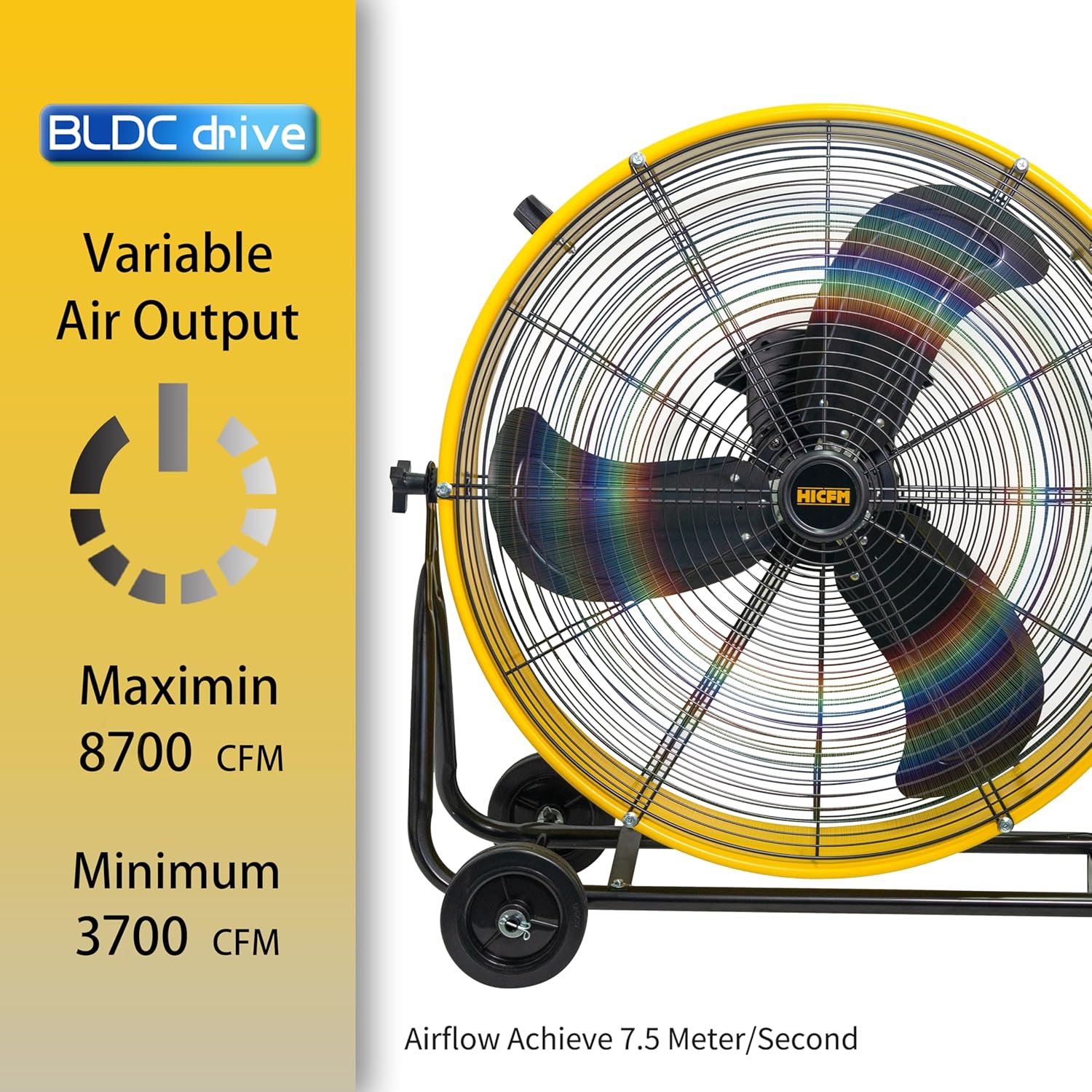
Industrial spaces punish unrated equipment. You must prioritize robust build quality and strict safety compliance to protect your workforce.
High-speed steel blades pose a severe amputation risk. You must insist on tightly spaced, concentric wire guards. These specialized grilles prevent errant fingers, dropped tools, or loose warehouse debris from contacting the spinning blades. Always verify OSHA compliance before placing any fan on an active warehouse floor.
Ingress Protection (IP) ratings objectively measure a machine's defense against solids and liquids. A standard warehouse cooling fan strictly needs protection against heavy airborne dust. Standard indoor models handle dry environments perfectly. However, washdown bays or open shipping docks face harsher elements. Areas exposed to driving rain or cleaning jets demand fully enclosed motors. Look for Totally Enclosed Fan-Cooled (TEFC) designs. Ensure they carry high IP ratings, such as IP55 or IP65, to prevent catastrophic electrical failures.
Flimsy plastic housings crack easily under industrial stress. We highly recommend powder-coated steel or heavy-duty aluminum barrels. Warehouses endure inevitable, daily impacts from fast-moving pallet jacks and heavy forklifts. Metal barrels absorb these strikes and survive these harsh realities. The powder-coated finish also actively resists rust and chemical corrosion over years of use.
A stationary fan offers limited value in a dynamic logistics center. You must evaluate how easily your team can maneuver and manage the equipment.
Heavy fans require robust mobility features. Evaluate the chassis closely. Look for solid rubber or thick pneumatic wheels. Demand a minimum wheel diameter of 8 inches. Large wheels easily clear thick extension cords, uneven dock plates, and random floor debris. Additionally, check the handle design. Ensure ergonomic placement allows a single worker to safely tip and roll the unit without straining their back.
Tripping hazards remain a critical warehouse safety risk. Loose wires easily cause severe falls. Look for models featuring heavy-duty, brightly colored SJT power cords. Demand a minimum cord length of 10 feet to reach distant outlets safely. The chassis must include integrated cord-wrap brackets. Proper cord management helps your facility maintain strict 5S organizational safety standards.
Never ignore the acoustic footprint of heavy machinery. A large industrial fan easily pushes past 75 decibels. This loud operating volume can drown out vital forklift warning horns. It also actively disrupts team communication during complex tasks. Always check the official decibel (dB) rating at maximum RPM. Place louder direct-drive units near heavy machinery zones. Reserve quieter belt-drive units for communication-heavy dispatch or staging areas.
Use this streamlined logic to finalize your equipment choices confidently.
Step 1: Define the target zone size. Measure the specific square footage requiring immediate cooling. Calculate the minimum CFM needed to turn the air over efficiently in that precise area.
Step 2: Assess the environment. Analyze your air quality and moisture levels. Clean, dry areas permit standard open motors. Dirty, dusty, or wet areas strictly dictate sealed TEFC motors.
Step 3: Evaluate noise sensitivity. Map your communication zones. Quiet staging areas require belt-drive fans. Extremely loud machinery or stamping areas easily accommodate louder direct-drive units.
Step 4: Check facility power. Verify your electrical infrastructure. Ensure your standard 115V wall outlets can easily handle the startup amp draw of the chosen motor. Avoid tripping breakers during busy shifts.
Effective warehouse cooling relies on matching robust equipment to exact, localized needs. You gain nothing by overspending on mismatched, overpowered specifications. A properly selected fan transforms sweltering danger zones into comfortable, highly productive workspaces.
Always prioritize CFM outputs tailored to specific zone dimensions, avoiding disruptive over-ventilation.
Select motor drives based on your daily noise tolerance and long-term maintenance bandwidth.
Never compromise on OSHA-compliant grilles or appropriate IP ratings for wet environments.
Take immediate action today. Measure your specific problem areas on the warehouse floor. Review your internal facility safety requirements. Then, consult a detailed industrial product catalog using this precise criteria to find your perfect cooling solution.
A: A quick rule of thumb for spot-cooling is to calculate the volume of your specific work zone (Length x Width x Height). Divide that total volume by your desired air exchange rate (typically 2 to 5 minutes). This yields your minimum baseline CFM requirement for that isolated area.
A: No, standard models belong strictly indoors. You must check the IP rating. Standard fans lack sealing against moisture and rain. Leaving them outside invites rapid rust and electrical shorts. Only use fans explicitly rated for outdoor or wet locations (often featuring TEFC motors) in exposed areas.
A: A pedestal fan provides a wide, diffuse airflow meant to sweep gently across a broad, open room. A drum fan utilizes its deep cylindrical barrel to channel air into a focused, high-velocity tunnel. This tunnel pushes intense air deep into aisles or trailers.
A: Better depends entirely on your application. Belt-drive units excel in quiet, continuous-use scenarios moving massive air volumes. Direct-drive units are better for buyers seeking compact footprints, lower initial costs, and absolutely zero belt maintenance over the lifespan of the machine.


