- All
- Product Name
- Product Keyword
- Product Model
- Product Summary
- Product Description
- Multi Field Search
Please Choose Your Language


Views: 0 Author: Site Editor Publish Time: 2026-09-07 Origin: Site


Facilities face a constant operational conflict known as the ventilation paradox. Workers demand robust airflow to maintain safety and peak productivity during demanding shifts. Floor-level cooling equipment, however, consumes premium square footage and continually interrupts daily workflows. We understand you cannot sacrifice vital staging areas for oversized pedestal units. We see a distinct strategic advantage in relocating these systems to unused vertical real estate. Elevating your ventilation equipment completely eliminates dangerous tripping hazards and optimizes busy floor layouts. You instantly reclaim workable space without sacrificing essential employee comfort. This article provides a transparent, technical framework for evaluating wall-mounted airflow solutions. We will help you navigate facility spatial constraints, core airflow physics, and strict commercial durability requirements. You will learn exactly how to choose the right fan to improve your operational efficiency.
Elevating fans reclaims active floor space, mitigates OSHA compliance risks (trip hazards), and prevents equipment damage from forklifts or foot traffic.
Wall-mounted fans do not lower absolute room temperature; they cool occupants via the evaporative "wind chill" effect and disrupt thermal stratification by circulating trapped upper-level air.
Selecting an industrial wall fan requires evaluating CFM (Cubic Feet per Minute) output, motor enclosure types (e.g., TEFC), and structural mounting requirements.
Oscillating and high-velocity directional models serve fundamentally different use cases (wide-area circulation vs. targeted spot cooling).
Pedestal and drum fans frequently disrupt daily workflow. You often find them blocking narrow aisles, busy loading docks, and tight utility spaces. Commercial kitchens face similar operational bottlenecks. Workers must navigate around bulky fan bases during peak service hours. Forklifts maneuver awkwardly to avoid crushing expensive cooling units. This friction slows down production and creates unnecessary frustration for floor staff. Proper warehouse ventilation should support operations instead of hindering them.
Safety implications extend far beyond simple inconvenience. Floor-based fans introduce serious safety and compliance risks. Trailing extension cords create severe tripping hazards across active walkways. Top-heavy pedestal units carry a high tip-over risk during accidental collisions. Safety inspectors actively look for obstructed paths during routine audits. You risk serious OSHA citations if safety routes remain blocked. Moving equipment upward mitigates these direct safety liabilities entirely.
We must also calculate the hidden spatial ROI. A standard drum fan consumes roughly a 3x3 foot footprint. Multiply this footprint across a large facility utilizing twenty units. You suddenly lose 180 square feet of premium operational capacity. Reclaiming this zone significantly increases usable staging areas. You open up critical square footage for extra pallets or assembly stations.
Common Mistake: Facility managers often accept floor clutter as a necessary evil. They ignore the vertical real estate available on perimeter walls and structural support columns.
Many people misunderstand how air circulation truly functions. Fans cool people rather than empty rooms. We need to debunk the persistent temperature myth. A standard fan cannot lower the absolute ambient temperature. Instead, it relies on a specific thermodynamic principle. Accelerated sweat evaporation creates a localized wind chill effect. Fast-moving air brushes against human skin. It strips away body heat and evaporates moisture rapidly. A dedicated wall mounted cooling fan maximizes this perceived temperature reduction for staff.
Elevated mounting also addresses thermal destratification. Basic physics dictates hot air rises to the ceiling. Warehouses and factories often trap enormous heat pockets near the roof. Mounting a fan at an elevated angle solves this problem. The downward trajectory pushes stagnant, hot air toward the floor level. This action creates a continuous convection loop inside the room. Air constantly mixes, preventing those localized and oppressive heat pockets.
We must consider airflow trajectories to understand this spatial advantage. Floor fans lose velocity rapidly in busy environments. Machinery, stacked inventory, and busy workstations block their horizontal air paths. The breeze dissipates long before reaching the intended workers. An elevated unit features a completely unobstructed throw. It shoots air over ground-level obstacles effortlessly. You get maximum air velocity exactly where workers need it most.
Best Practice: Angle your fan downward between 15 and 30 degrees. This specific tilt captures warm ceiling air and forces it directly into the human occupation zone.
Facility needs dictate the choice between stationary and sweeping airflow. Let us examine the two primary categories to optimize your cooling strategy.
The high velocity wall fan represents the directional, fixed-position solution.
Best for: Spot cooling specific machinery, deep continuous aisles, or specific high-heat workstations.
Pros: It delivers maximum concentrated velocity over much longer distances. Fixed models push air forcefully in a single straight line. They excel in environments demanding intense, targeted relief.
Oscillating units provide a completely different airflow pattern.
Best for: Broad coverage in loading bays, assembly lines, or irregularly shaped rooms.
Pros: The unit sweeps a wider area effectively. It prevents continuous, fatiguing drafts on a single worker.
Evaluation Note: Oscillation mechanisms introduce internal moving parts. These gears are often the first point of mechanical failure in lower-grade units. You must prioritize high-quality construction.
Here is a quick summary chart for your decision-making process.
Wall Fan Selection Guide
| Feature | Fixed/High Velocity | Oscillating |
|---|---|---|
| Primary Use Case | Targeted spot cooling | Broad area circulation |
| Airflow Range | Long, narrow corridor | Wide, sweeping arc |
| Mechanical Complexity | Low (fewer moving parts) | High (internal gears) |
| Worker Impact | Intense, continuous breeze | Intermittent, gentle breeze |
Selecting the proper equipment requires moving beyond basic marketing metrics. Do not just look at raw CFM (Cubic Feet per Minute). A high CFM means little if the breeze cannot reach the worker. You must evaluate the CFM-to-Distance ratio instead. Look at the Velocity or FPM (Feet per Minute) at specific distances. This confirms the air actually penetrates the target operational zone. You need to feel the breeze 20 feet away.
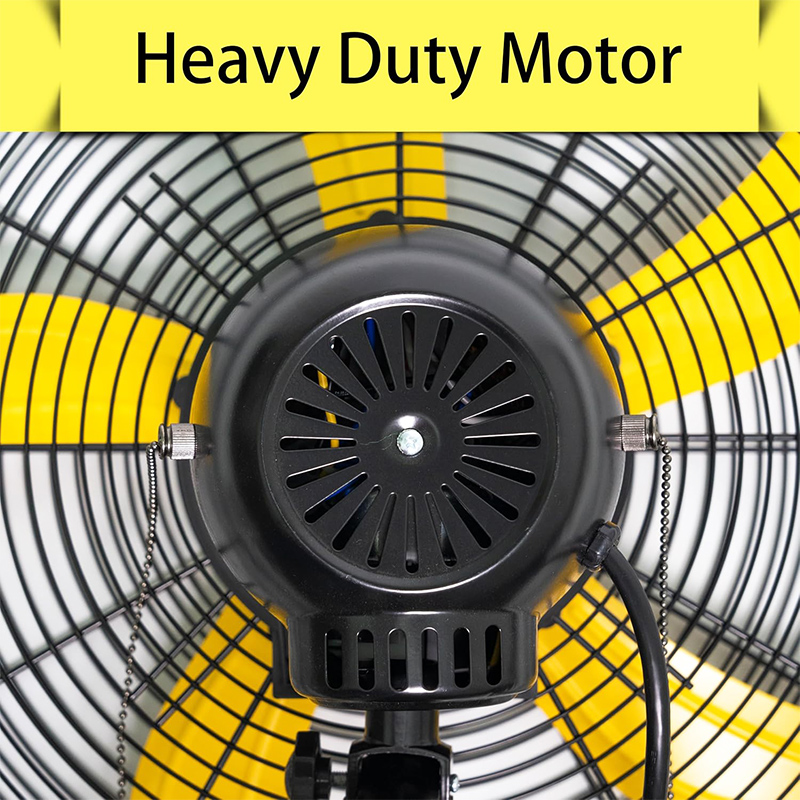
Motor durability heavily influences the lifespan of your investment. We must differentiate between common motor enclosures. Open Drip Proof (ODP) motors allow air to circulate freely through the windings. Totally Enclosed Fan Cooled (TEFC) motors seal the internal components completely. Environments containing heavy dust, moisture, or airborne particulates strictly require TEFC motors. These sealed units prevent debris from entering the casing. They stop premature motor burnout in harsh manufacturing environments. A true industrial wall fan normally utilizes this fully enclosed architecture.
Blade pitch and material selection also demand attention. Steeper blade pitches grab and push significantly more air per rotation. However, this steep angle requires a much more robust motor to spin. It also generates considerably more noise during operation. We strongly recommend aluminum or galvanized steel blades for commercial environments. Plastic blades warp under extreme heat and lose their aerodynamic efficiency rapidly.
Common Mistake: Purchasing an ODP motor for a dusty woodworking shop. Wood dust coats the internal motor windings, causing overheating and rapid failure within months.
Wall mounting introduces specific structural challenges. An industrial fan's heavy weight and operational vibration cause significant structural stress. We strongly warn against mounting high-velocity units on standard drywall. Drywall lacks the necessary sheer strength to hold vibrating equipment. You must install proper wood or metal backing inside the wall first. Failure to follow this rule risks catastrophic equipment detachment.
Hardware requirements demand strict adherence to industrial standards. Standard screws will fail under constant mechanical vibration. Follow these structural guidelines:
Use heavy-duty lag bolts for solid wood beams and studs.
Install specialized masonry anchors for brick or concrete block walls.
Deploy rated steel beam clamps for exposed metal I-beams.
Vibration fatigue easily loosens inadequate hardware over several months. You must check these mounting points during routine maintenance cycles. A sturdy commercial wall fan requires uncompromised structural integrity to operate safely over time.
Electrical planning often trips up installation teams. You must choose between hardwiring the units or using traditional plug-in models. Hardwiring requires a licensed electrician and dedicated circuits. Plug-in models offer easier setup but require strategically placed wall outlets. Draping long power cords down the wall completely defeats your initial goal. Loose cords reintroduce the exact floor clutter you aimed to eliminate initially.
Your facility layout dictates your specific airflow strategy. Assess your total square footage carefully before purchasing new equipment. Identify solid structural mounting points along your perimeter walls or internal support columns. Choose fixed spot cooling for narrow workstations or area cooling for wide assembly zones. Always specify the correct motor enclosure to survive your unique environmental hazards.
Take a walk through your facility this week. Audit your floor space to locate immediate hazard zones. You will easily spot areas where trailing cords and bulky floor fans endanger workers. Consult your maintenance team regarding structural mounting capacities. Transitioning to elevated ventilation improves workflow, boosts safety compliance, and enhances worker comfort simultaneously.
A: No. Fans cannot alter the absolute ambient temperature of a sealed room. They cool occupants through the evaporation of moisture on the skin. In fact, the fan motor introduces a negligible amount of heat into the space.
A: Generally, 7 to 8 feet above the floor is optimal. This clears head height to prevent injury, avoids ground-level obstacles, and provides an ideal downward angle (typically 15 to 30 degrees) to hit the working zone effectively.
A: High-velocity models generate significant decibels due to aggressive blade pitches and high RPMs. For acoustically sensitive areas, evaluating the noise rating (dBA) and opting for variable-speed models or slightly oversized fans running at lower speeds is recommended.


